How HR Leaders Drive AI Automation Projects That Deliver Real Business Impact
Artificial Intelligence is rapidly transforming human resources, but most organizations are still struggling to move beyond disconnected tools and pilot programs. While AI adoption in HR is accelerating, true value only emerges when AI automation projects are aligned to strategy, data, and people.
This is where the AI Maturity Model for HR becomes essential.
The model helps HR executives understand:
-
Where their HR organization sits today
-
How individual HR professionals are engaging with AI
-
What it takes to scale AI automation responsibly across HR functions
AI maturity in human resources is not about technology alone—it’s about leadership, operating models, governance, and workforce readiness.
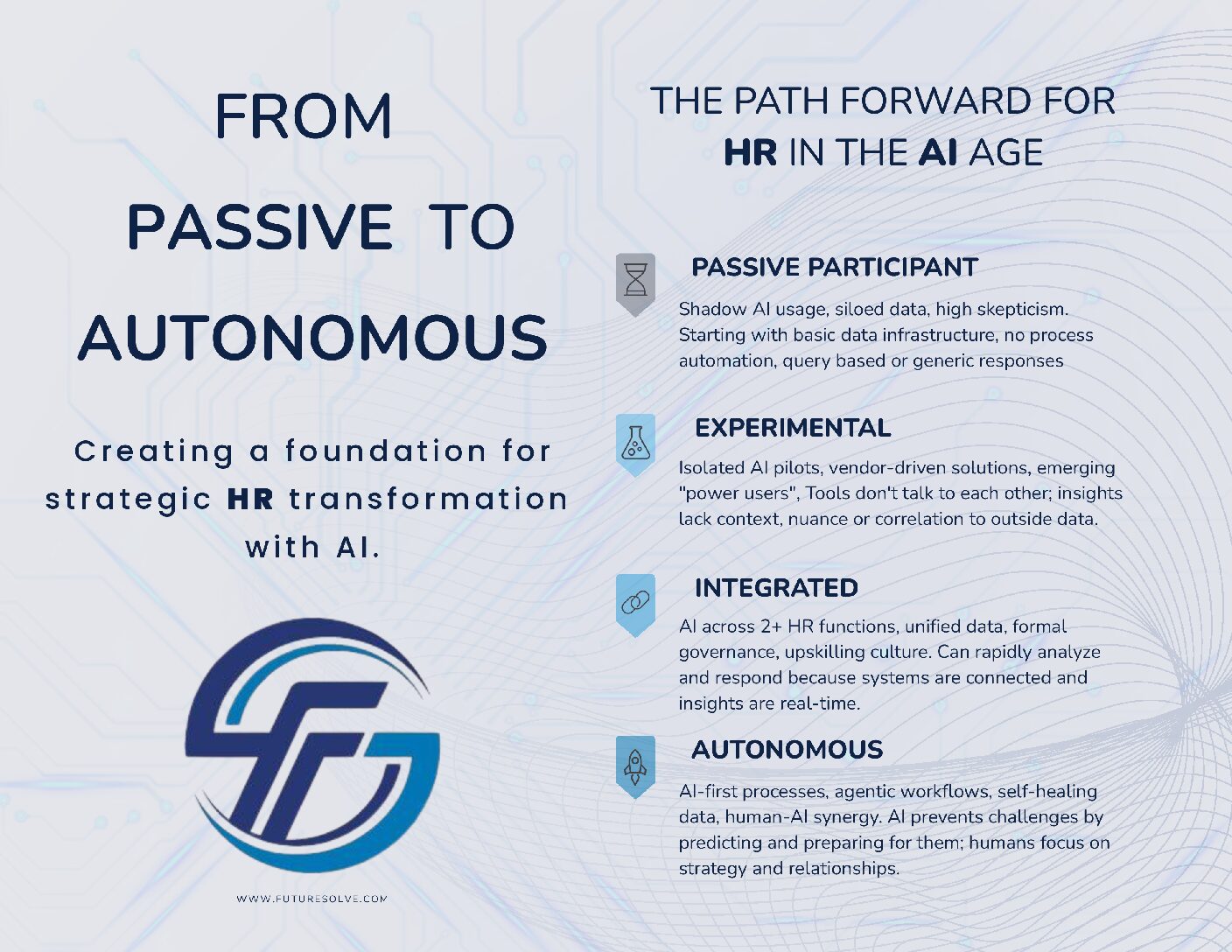
Stage 1: Passive Participant
AI in HR exists—but without strategy or structure
Enterprise HR reality
At this stage, HR organizations experience shadow AI usage, siloed HR data, and skepticism toward AI-driven automation. There is no enterprise AI strategy for human resources, and AI tools are adopted informally or avoided altogether.
Individual HR professionals
HR teams rely on manual processes, have low AI literacy, and lack guidance on responsible AI use. AI is perceived as risky rather than valuable.
Business risk
-
Compliance and data privacy exposure
-
Missed efficiency gains from HR automation
-
HR falling behind finance, operations, and marketing in AI adoption
How HR leaders move forward
To progress, HR executives must:
-
Establish baseline AI literacy across HR
-
Define clear guardrails for AI use in human resources
-
Position AI automation as a workforce enabler—not a workforce threat
The goal is confidence and clarity, not immediate automation at scale.
Stage 2: Experimental
HR AI automation projects are happening—but in isolation
Enterprise HR reality
Organizations begin launching isolated AI automation projects—often driven by vendors rather than business needs. AI may appear in recruiting, employee engagement, or learning platforms, but systems remain disconnected and insights lack context.
Individual HR professionals
Some HR professionals become “power users,” leveraging AI for:
-
Drafting employee communications
-
Summarizing policies
-
Improving personal productivity
However, AI use remains fragmented and self-directed.
Business risk
-
AI tools don’t scale across HR
-
ROI is anecdotal rather than measurable
-
HR leaders struggle to justify broader AI investment
How HR leaders move forward
Progress requires shifting from experimentation to intention:
-
Align AI automation projects to HR and business outcomes (e.g., turnover reduction, time-to-hire)
-
Begin integrating data across HR systems
-
Introduce light governance to ensure ethical and compliant AI use
This is where HR transitions from tool adoption to AI strategy.
Stage 3: Integrated
AI automation is embedded across human resources
Enterprise HR reality
AI is now integrated across multiple HR functions—talent acquisition, learning and development, workforce planning, compensation, and employee relations. HR data is unified, governance is formalized, and insights are available in real time.
Individual HR professionals
HR teams:
-
Use AI-driven insights to inform decisions
-
Collaborate with IT, data, and AI teams
-
Embed AI into daily HR workflows
AI automation improves both efficiency and decision quality.
Business value
-
Faster, data-driven HR decisions
-
Improved workforce planning
-
Stronger alignment between HR strategy and business strategy
How HR leaders move forward
To reach the highest level of maturity, HR executives must:
-
Invest in predictive analytics and workforce intelligence
-
Redesign HR roles around judgment, insight, and influence
-
Measure AI success by business impact, not tool usage
Stage 4: Autonomous
AI-first human resources organizations
Enterprise HR reality
At this stage, HR operates with AI-first processes and agentic automation. AI systems anticipate workforce risks, identify skill gaps, and recommend interventions before issues arise. Data is self-healing, and automation is continuous.
Individual HR professionals
HR leaders focus on:
-
Organizational design
-
Culture and change management
-
Long-term workforce strategy
AI handles analysis and prediction; humans focus on leadership, ethics, and relationships.
Competitive advantage
Organizations with autonomous HR AI capabilities:
-
Respond faster to market changes
-
Build future-ready workforces
-
Position HR as a strategic driver of enterprise value
Thought Leadership: The New Role of HR in AI Automation
AI automation in human resources is no longer optional—it is a core leadership capability.
The most effective HR executives today:
-
Treat AI automation projects as strategic investments
-
Balance innovation with trust, ethics, and governance
-
Upskill HR teams to work confidently alongside AI
-
Lead enterprise-wide change, not just HR transformation
AI will redefine how HR operates. The only question is whether HR leaders will shape that future—or react to it.

Author: Andy Najjar
Admin

Building an HR AI Governance Framework for Executive Leadership
FutureSolve Joins Leading HR Voices in the Age of HR
The AI Maturity Model for HR

The Next Frontier in Workforce Risk Mitigation

Why A.I. Adoption is Starting with HR: The Rise of Agentic A.I. and the Strategic Role of HR Leaders

How to Use AI Agents to Automate HR Administrative Tasks

Predictive HR Analytics: Revolutionizing Workforce Management

HR Management: Navigating the Complex Landscape of Human Resource

Implementing AI for Turnover Prediction: A Step-by-Step Guide

AI-Driven Benefits Optimization: Enhancing Employee Satisfaction

Navigating Legal Compliance with AI-Powered HR Solutions

Leveraging AI for Predictive Hiring: FutureSolve’s Cutting-Edge Approach

Succession Planning: Ensuring Organizational Continuity and Growth

AI-Driven Retention Strategies: How FutureSolve Reduces Turnover

Top HR Management Strategies and Skills: Driving Organizational Success

Understanding the Pay Transparency Directive in the European Union

AI in Performance Management: FutureSolve’s Revolutionary Approach

AI-Driven Hiring: Transforming Recruitment

CHRO Crisis Management: FutureSolve’s Executive Support